How Do You Want to Feel? A Therapist's Framework for Exploring New Kinks
Image by UX BEX

DISCLAIMER:
This article is by no means a comprehensive list, or approach to, kink and BDSM. It’s a very basic primer to help folks get curious about where their interests lie and how they might all tie together. Each kink or act listed in this article has years of history and context within it that is beyond the scope of this article.
Additionally, this article is looking at how sex therapy can help someone have a more active kink practice and what some therapeutic benefits of kink might even be. But let’s be clear: kink does not need to be “therapeutic” in order for it to be valid (or worthy of legal protection, for that matter). You can do kink because it’s fun, it’s hot, it gets you off, or it’s just something to do. With all that said, let’s dive in.
Most people come to kink exploration backwards. Folks often start with a specific act (spanking, flogging, wax play, etc.) and hope that a particular feeling will follow. But desire rarely works this way in practice. In reality, we often have no idea how a particular act might feel until it’s already happening. And even then, how particular acts make us feel varies greatly moment to moment – a spank that feels great in one scene with one person may feel terrible in and with another. While starting by exploring certain acts can be a useful entry point, it can fall flat pretty quickly. This is why, in my kink-positive sex therapy practice, I help clients explore their kinks by first exploring their feelings.
I’ve talked about how the therapy room functions like a container, a space where clients can experience difficult emotions safely and without being too overwhelmed. Kink, at its best, operates in the same way; kink necessitates a deliberately constructed, consensually negotiated, carefully boundaried container in which people can feel things they don't ordinarily let themselves feel. Which means that exploring kink, for many of my clients, isn't peripheral to their therapeutic work, but central to it.
As a sex therapist who's also a leatherdyke, I think frequently about how experience maps onto desire - both inside the session and outside it. When opening discussion with clients, I tend to refer to a kind of framework, or a matrix, for helping people explore new kinks. The entry point is deceptively simple: How do you want to feel?
Why Start with Feeling?
Let me be clear first: there’s nothing wrong with exploring kink act-first. Many folks arrive at kink this way, through excitement at the unexpected burn of hot candle wax or the surprising thrill of having blood drawn at the doctor. Especially for neurodivergent folks, self-inflicted pain can be a preferred method of self-soothing long before someone has even heard of kink. Asking a partner to spank or choke you can open up the door to exploration in ways previously unheard of.
And yet. Many folks who start out seeking specific acts quickly get bored when the only thing they know how to ask for is a singular sensation. I like to think of kink as a conduit for feelings, not necessarily the other way around. Particular kink acts (as well as language, outfits, and power dynamics) are not just activities or accoutrement, but tools at our disposal. With this understanding, we can not only build toward the feeling we desire to experience, but can also call on our own power to elicit that feeling in a million different ways. This allows us to ask the questions “what is it, actually, that I’m seeking, and how would I like to get there?”
From there, the framework for exploring kinks opens into two broad and deeply interconnected categories: physical sensation and emotional experience.
Often, what people fear their
desires say about them turns out to be more benign than the shame they've accumulated around it.
The Physical Dimension: Sensation as Language
Most of us have spent a significant portion of our lives learning to ignore our body’s language. Sex-related anxiety, in particular, is often a learned disconnection from physical experience; somatic shut-down or dissociation can get coded over time as "normal." Part of what kink exploration can do is begin to reconnect people with physical sensation as information rather than threat.
Sexual / Genital Sensation
When we talk about “sex,” we’re usually actually talking about genitals. Asking someone about their preferences for “genital touch” may not sound very sexy to you (which, like, fair enough), but asking yourself and your partners what they mean by “sex” will garner you a lot of helpful, and varied, results. Starting with what you want to feel genitally—or what you want a partner to feel—is not as straightforward as it might seem. Questions worth sitting with: Do you want a specific kind of stimulation against a specific part of your body? Do you want to feel full? Teased? Overwhelmed? Physically challenged—stretched, in the sense of exploring different toys or forms of penetration? Do you want to deliver those sensations to someone else? Even something as small as preferring to be touched in a circular motion vs. an up and down one can make a major difference in experience.
Naming what you want with specificity is a form of self-advocacy, and while immensely useful, it’s also incredibly vulnerable. So have patience and try not to worry too much if you can’t figure out all the most descriptive words right away; figuring it out is half the fun.
Non-Genital Sensation: The Spectrum from Pleasure to Pain
The physical dimension of kink isn't only about sex in the narrower sense. A lot of what makes kink powerful is the range of non-genital sensation available: tickling, featherlight touch, deep pressure, spanking, punching, containment, temperature play, and so on. Here the key question is: do you want your sensations to be purely pleasurable, purely painful, or some mix of both? And before you answer, know that "purely painful" and "purely pleasurable" are actually somewhat rare; pain and pleasure live much closer to each other than you might think.
Within the pain end of that spectrum, it's useful to understand two very different categories of sensation: sting and thud.
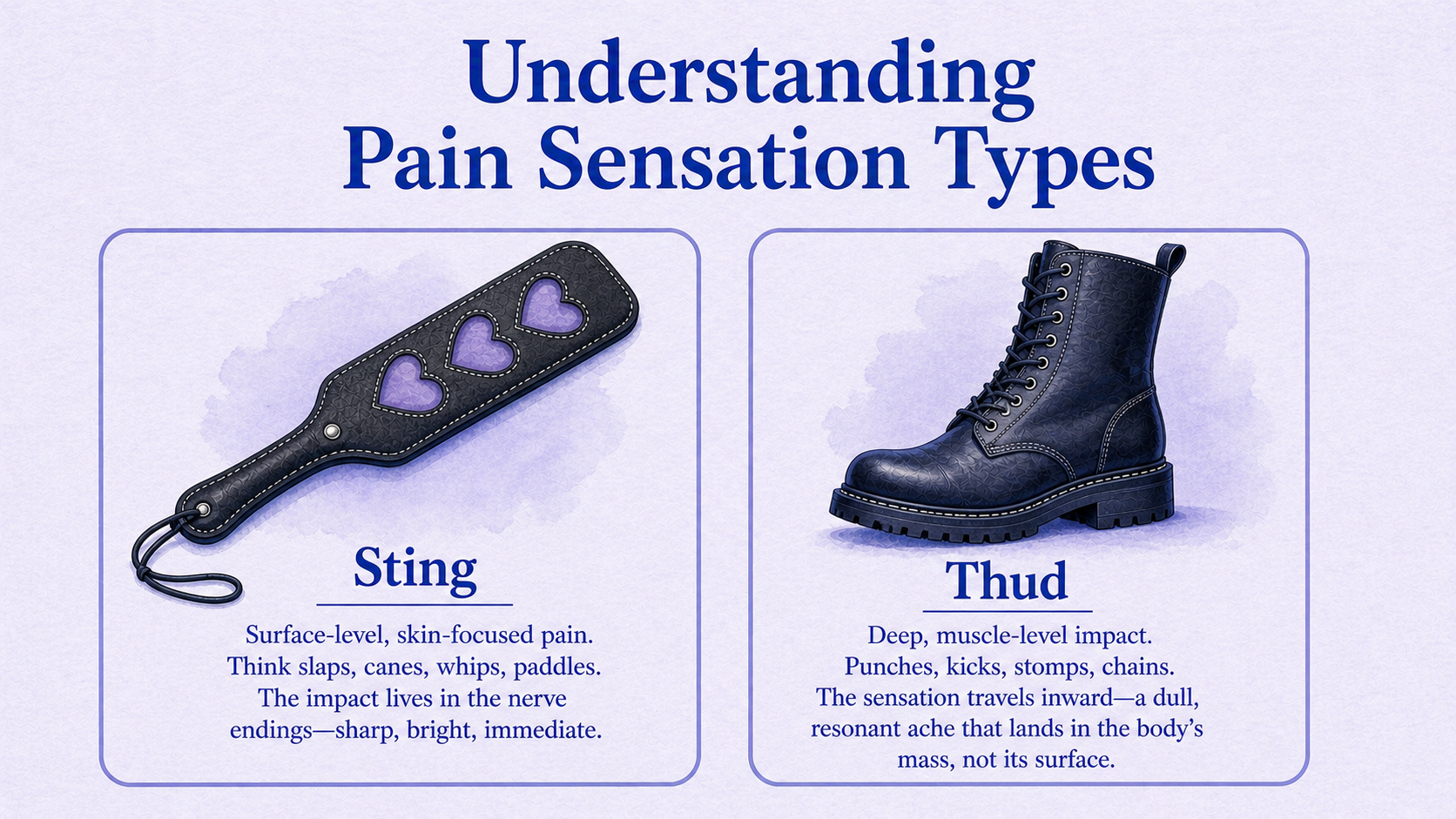
Image by UX BEX
Neither is better or worse. They simply feel different, and people have genuine preferences. Knowing which one (or which combination) speaks to you is useful information—both for your own pleasure and for communicating with a partner.
Pain can also shade into other territories: needles, cutting, and breath play, for example, introduce both a physical sensation (sharp, precise, often accompanied by adrenaline) and a significant psychological component—the activation of a fear response, the transgression of a body boundary, the particular charge of something that, culturally, carries a great deal of threat. For some people, that charge is the point, and for others, it’s a dealbreaker. Both are fine, so long as they’re negotiated with risk awareness in mind.

A word on safety:
There are parts of the body that should not be struck with significant force—the abdomen, the ribs, the lower back where the kidneys sit, joints like your knees, elbows, ankles, wrists. Starting with fleshier, muscular parts of the body are a safer bet–butt, thighs, breasts, upper back (avoid the neck and spine), though there is some degree of risk here too. Doing some research on how to hit someone in a safer way is definitely a good idea before you start actually doing it.
Containment, Bondage, and the Question of Pressure
Some people want to feel held. Not metaphorically—physically held. Squeezed, contained, immobilized. This is a large part of what bondage is about, and it's worth parsing out more finely than the cultural imagination usually does.
Contaiment can vary greatly in pain and intention—something like the pressure from being bound in rope can feel like a comforting, firm hug, or it can feel like unrelenting torture. And of course, part of the fun can be going back and forth between the two sensations. In that vein, predicament bondage occupies an interesting hybrid space: it’s bondage that also involves a psychological challenge, often forcing the person being bound to choose between two uncomfortable options. This is where physical and emotional experience start to blur into each other, and where some of the most interesting self-discovery tends to happen.
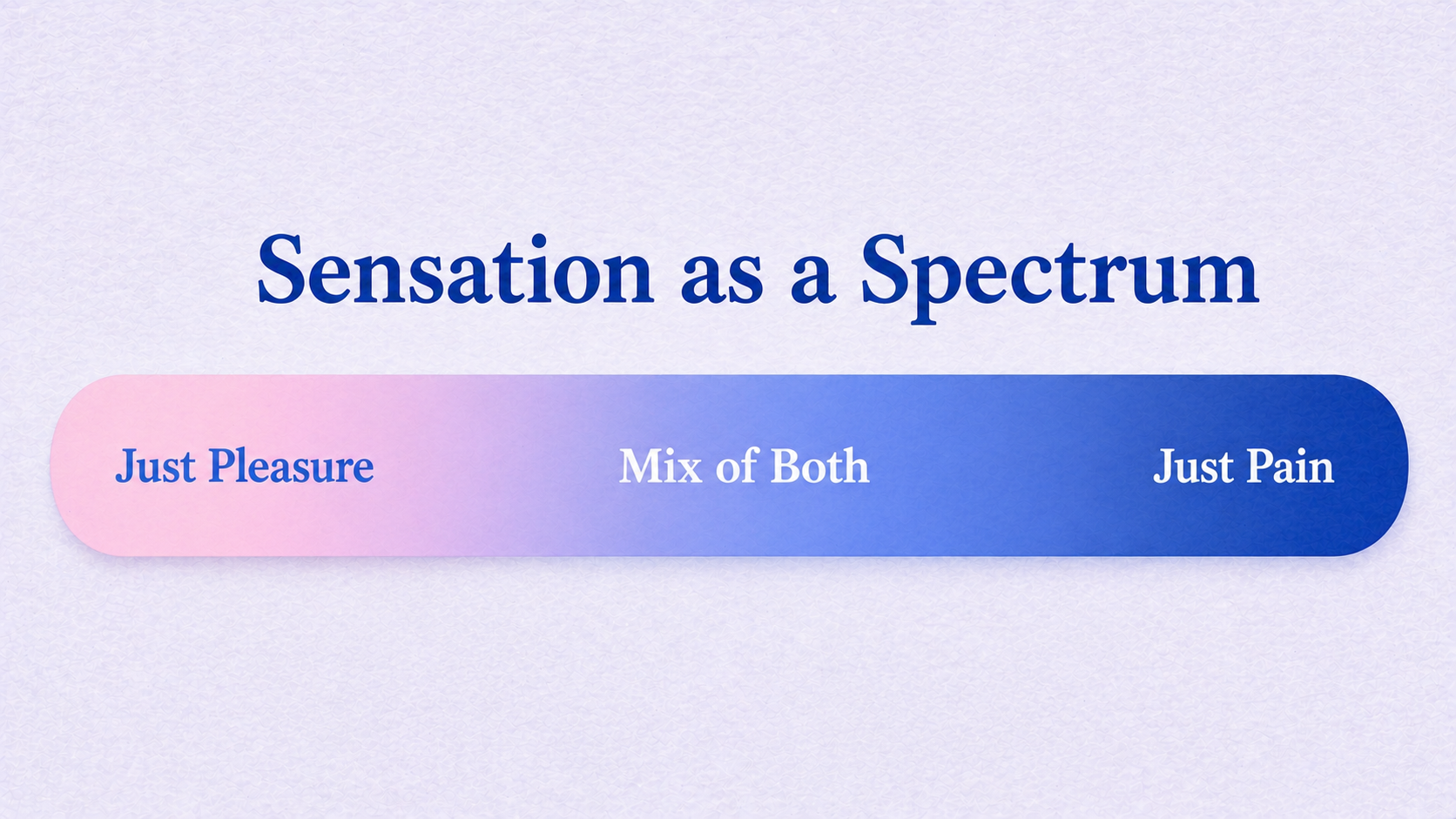
Image by UX BEX
All of these sensations exist on a wide spectrum of intensity, and intensity is not fixed—it's calibrated. The same sensation can feel very different depending on context, arousal level, emotional state, and who's delivering it. One of the gifts of kink exploration is developing a more granular literacy around your own nervous system: what amplifies sensation for you, what dulls it, and what crosses a line.
The Psychological Dimension: Emotion as the Real Architecture
Most kink, when you strip it down, is about producing or inhabiting a particular emotional state in a context where that emotion is deliberately constructed, consensually invited, and (ideally) processed afterward. The question "how do I want to feel?" carries real weight; the honest answers often illuminate things people haven't fully let themselves look at.
Desired Emotional States
The emotional landscape of kink is wider than it's usually given credit for. On one end: feelings of being held, cared for, cherished, worshiped, completely seen and tended to. On the other end: shame, degradation, dirtiness, objectification. And then the full spectrum in between—and the option to move across that spectrum within a single scene.
For clients who struggle with shame around their desires specifically, it can be profoundly disorienting to discover that what they want is to feel, in a bounded and consensual way, the very shame they've spent years trying to escape. This is one of the places where a kink-affirming clinical framework becomes important: the goal is not to pathologize the desire, but to understand the function it serves and what it might be pointing toward.
Power Play: Domination and submission, sadism and masochism
Power dynamics are their own vast territory. At the very core, Domination and submission come down to the question of: do you want to be the one in control or the one being controlled? This question functions similarly for sadism and masochism: do you want to be the one hurting someone or do you want to be the one getting hurt? The definitional boundaries around these four terms are fluid and can be switched between repeatedly, even across the duration of a single scene. If a Dom commands their sub to punch them, when they know the sub really hates hurting other people, who’s really in control? Who’s really hurting whom? This also goes for top and bottom, which generally pertains to giving vs. receiving for sex, but can be used to describe generally who is doing what in a scene. But again–if a top is ordering their bottom to go down on them, for example, who’s really bottoming?
Dominant, submissive, sadist, masochist, top, bottom—and within each, enormous variation in what that actually means, what gets exchanged, and what the relationship between the two positions produces emotionally for each person. The question of how you want to feel includes where you want to sit in the power structure, and for how long, and under what conditions.
Identity Play: Human, Object, Animal, Other
Some kink involves temporarily inhabiting a different identity or even species. Someone wanting to become, for the duration of the scene, a puppy, an ashtray, or a toy is common. Roleplay across positions of power, gender, and age can also occupy this space; some folks get hot playing as a mean teacher, others as a little kid. This kind of play maps meaningfully onto work I do with clients around identity flexibility, self-conceptualization, and the need to temporarily escape the weight of personhood. Wanting to take a pause, or even escape, from being one’s self isn’t inherently pathological. Being a human person is hard! For many people who carry a heavy sense of responsibility, hypervigilance, or chronic anxiety, the relief of temporarily ceasing to be the person making all the decisions, or being the person who has total control over what’s happening, can be genuinely therapeutic in its own right.
Duration, Dynamic, and Depth
Not all kink is scene-contained. Some people want a twenty-minute experience that ends cleanly. Others want the architecture of a 24/7 Dominant/submissive (D/s) dynamic—a sustained power structure that shapes their daily life. 24/7 D/s dynamics are fundamentally different in their psychological demands, their relational implications, and what they require in terms of communication, trust, and aftercare. And of course, there are a lot of different possibilities for play intensity and duration between a 20 minute scene and a 24/7 D/s dynamic.
The Trauma and Insecurity Variable
This is probably the most clinically significant section of the framework, and the one I spend the most time on with clients.
Virtually every kink experience has the potential to brush up against personal insecurity or prior trauma. Degradation might touch a wound that has nothing to do with the scene. Bondage might activate a nervous system that learned to associate helplessness with danger. A caretaking dynamic might invoke attachment injuries that predate any sexual relationship.
This isn't a reason to avoid those experiences. In fact, for some people, consciously working with those edges in a contained, consensual setting can be one of the most healing experiences available to them—precisely because, unlike the original wound, this one is chosen, and is therefore proof of agency. But it requires honesty. The question isn't just "how much do you want to feel this?" it's also: "do you know where this feeling comes from, and are you going into it with enough support to process whatever comes up on the other side?"
A popular approach to navigating consent in kink is called RACK: risk-aware, consensual kink. A major part of the risk involved in kink lies not only in the possibility for physical injury, but also for psychological and relational ones. Some folks who have been consensually “kidnapped” for the sake of the scene have developed real PTSD afterwards. Some folks who play with a “Mommy” incur attachment wounds when that Mommy isn’t emotionally available to them outside of play. Playing “within your limits” means understanding what’s at stake when you engage in kink and being willing to engage with the possibility of suffering long after the spanking is over.
The Full Matrix: Environment, Aesthetics, and Everything Else
Physical sensation and emotional experience are the two main branches, but they're not the whole tree. Kink is also deeply shaped by environmental and aesthetic factors (what the space looks, smells, and sounds like; what everyone is wearing; what the lighting is; whether there's music)that operate as a kind of sensory context to situate the experience. A scene in a well-lit living room with the TV on in the background produces a very different experience than the same scene in a dark room with deliberate ambiance. Both options are fine, but the setting is doing work that's worth attending to.
And then there's everything else that makes an experience feel right beyond just its technical components: the specific person, the specific relationship, the specific garment that does something indescribable to your sense of self, the particular sensory combination that turns out to activate something you had no words for. The matrix is less a complete map than it is a starting point for self-inquiry.
What This Looks Like in a Therapeutic Context
For clients who come to me with sex-related anxiety, unexplored desires, or a general sense of being stuck - unsure why their sex life feels flat, or why they can't stop thinking about something they're ashamed to want - this framework serves as a kind of structured permission. A way of approaching the question of desire with curiosity rather than verdict.
I don't tell clients what to want, or what's healthy to want. What I do is help them get specific about what they're already wanting, understand what function that wanting serves, and figure out whether they have the internal resources to explore it as safely as they can. Often, what people fear their desires say about them turns out, on examination, to be considerably more benign than the shame they've accumulated around it.
Let’s connect
If you're navigating questions about desire, sex-related anxiety, or kink exploration and think therapy might be a useful part of that process - let’s explore this together!
I

My name is Caryn Sherbet (they/them) and I am a licensed psychotherapist based in Brooklyn, New York.
My boundary-expansive approach empowers my clients in overcoming challenges and embracing “otherness”.
I offer unique expertise in treating many conditions of the human experience, including:
OCD, anxiety, and/or rumination
Chronic illness and/or pain
LGBTQ+ Identity
Understanding relationship patterns and/or conflict
Sexual “dysfunction” and associated experiences
Self-conceptualization, meaning-making, and finding purpose
Read more about





The information in this blog is for educational purposes only and is not intended to be a substitute for professional mental health advice, diagnosis, or treatment.
Interaction with this blog, including comments or messages, does not constitute a therapist-client relationship. If you are in crisis, please call 911, go to the nearest hospital emergency room, or call a crisis hotline (988) immediately.