Why “Maxxing” Your Life Won’t Save You from Death
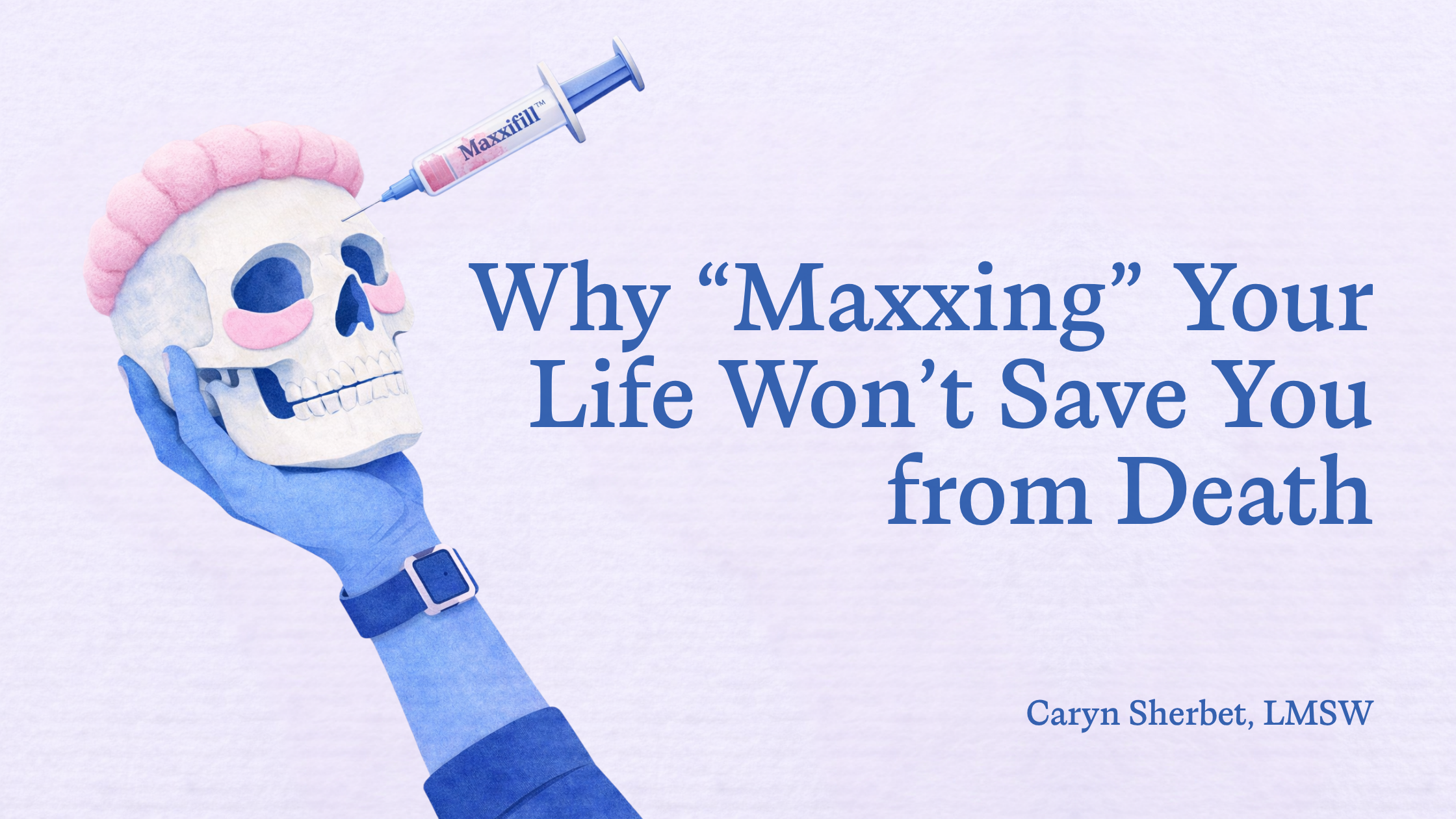
Image by UX BEX
Scroll through any social media feed for more than five minutes and you'll encounter it: looksmaxxing, sleepmaxxing, softlifemaxxing, rawmaxxing. The promise is always the same — that with the right combination of habits, products, and routines, you can optimize yourself into a version of your life where nothing bad happens to you. Where you are, finally, in control.
I feel both curious about and critical of the wheels making maxxing culture turn. When I wrote about friction-maxxing a couple months ago, I was actually pretty enthusiastic about the concept — the deliberate embrace of difficulty as a path toward self-efficacy is my bread and butter. That's clinically adjacent to Exposure and Response Prevention (ERP), which I use every day with clients treating OCD and anxiety.
But the "maxxing" trend that has captured the cultural imagination — the biohacking, the optimization, the obsessive stacking of routines to become the most attractive, most productive, most immune-to-disappointment version of yourself — that's something different. And I think it's worth asking: what are we actually doing when we "maxx" our lives?
The Magical Thinking Underneath the Optimization
A thing I notice in my therapy work again and again is that many people come to therapy believing that if they do the right things in the right order, they can guarantee a particular outcome. I encounter a lot of “If I could just [insert difficult thing here], then I would be [happier, healthier, less terrified of the future].”
This is magical thinking. I don’t mean this in a dismissive way — it's a deeply human response to the unbearable reality that we have very little control over most of what happens to us. Magical thinking is a compulsion that runs on the belief that our behaviors, rituals, or choices can determine outcomes that are fundamentally outside our control. And "maxxing" culture is, at its core, magical thinking with a productivity influencer's aesthetic.
When someone is "looksmaxxing," they aren't just trying to feel more confident (though that might be part of it). They're trying to secure themselves against something—rejection, irrelevance, the creeping dread that their body is aging, that they are aging, that no amount of red light therapy panels will stop that from being true.
Maxxing is anxiety dressed up as a productivity hack.
Two Ways We Deny Death
Existential psychotherapy has a lot to say about what's really happening here. Irvin Yalom, one of the foundational thinkers in existential psychotherapy, wrote extensively about what he called "death denial" — the psychological strategies we employ to avoid confronting the reality of our mortality and the fundamental uncertainty of existence.
He identified two primary modes of death denial that are worth sitting with.
The first is the fantasy of the Ultimate Rescuer — the belief in some external force (a Messiah, a government, a self-care routine) that will ultimately shield us from death and destruction.
The second is the belief in one's own Unique Specialness — the deeply held, often unconscious conviction that while death and catastrophe may come for others, we ourselves possess some specialness that will allow us to evade it.
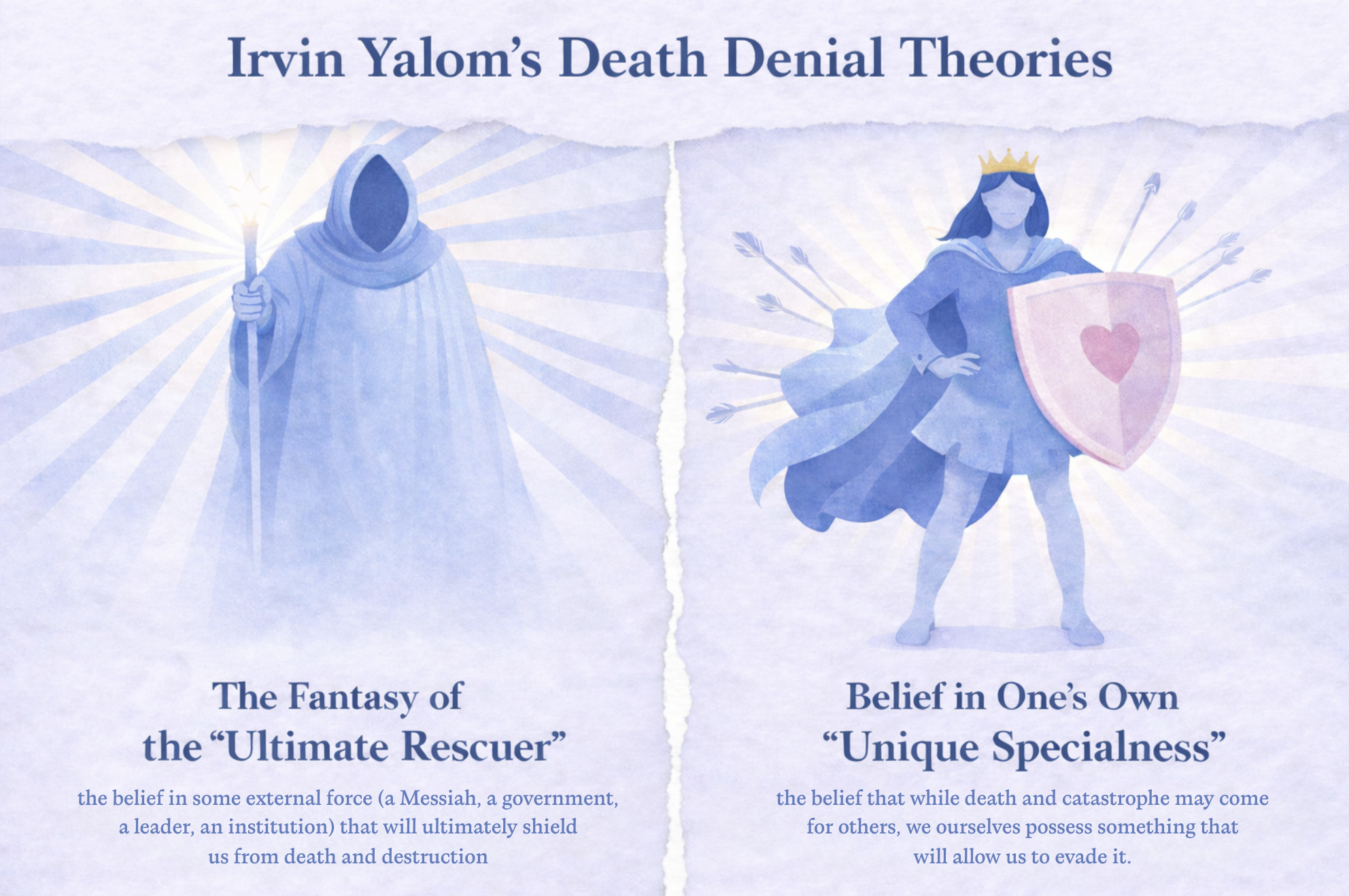
Maxxing ideology encompasses both of these forms of denial.
When someone commits to a rigorous protocol of cold plunges, NAD+ infusions, and sunlight exposure before 8am, there is often an implicit belief operating in the background: I am doing the work that others aren't willing to do, and this will protect me. There is another belief here that says this routine will be the thing that saves me. If I just put my energy into this routine, then I won’t have to take responsibility for my existence elsewhere.
Image by UX BEX
A Culturally Nascent Coping Mechanism
It's not an accident that maxxing culture has exploded in this particular historical moment. As I wrote in my piece on existential anxiety under fascism, anxiety is not an emotion — it's a coping mechanism. It is a way of experiencing the feeling of movement and control in a situation where we actually have none.
We are living through a period of profound collective instability, one in which we are confronted constantly with never-ending death and destruction worldwide. The collective grief, rage, and terror at what the future holds has become unbearable for us to feel directly, and so the maxxing trend has arisen as a convenient method of defending against such grief, rage, and terror, and therefore, against death.
Maximizing everything is paradoxically a way of avoiding your actual life.
What happens when it doesn’t work?
Here's the therapeutic problem with maxxing: it cannot do what it promises, and the failure of that promise tends to produce more anxiety, not less.
When a coping mechanism fails — when the outputs don't match the inputs, when the gray hair shows up anyway, when the relationship ends despite all the right self-improvement — there's a particular kind of devastation that follows. Not just disappointment, but a collapse of the entire logic that was being used to hold the existential terror at bay. As I noted in my existential anxiety piece, worrying is not activism, and optimizing is not actually self-improvement. No amount of maximization will get you to know what will happen in the future any faster, nor will it prevent how much a hard thing will hurt if and when it actually happens.
Maxxing culture is, in this way, an obsession with inoculating ourselves against disappointment. But you cannot inoculate yourself against being alive.
What Therapy Asks Instead
Therapy (ideally, anyway) does not help people create a better system of control, but instead helps people build a genuine capacity to tolerate the fact that control over one’s life is mostly a useful fiction. This means developing a real relationship with uncertainty, one that involves grief and panic and rage at the fact that you could do everything "right" and still lose something important.
Anxiety, as I keep saying, is a hamster wheel. It generates the sensation of movement — the feeling of doing something — without actual trajectory. Maxxing is anxiety with a content strategy. It is a way of staying on the wheel while convincing yourself you're going somewhere. What actually moves us forward isn't optimization. It's the willingness to feel. To grieve what we cannot control. To acknowledge, as existentialists have long insisted, that the weight of freedom is not the freedom to determine outcomes, but the freedom to respond to them.
That's the work. And it is not, despite what the algorithm would like you to believe, something that can be maxxed.
Let’s connect
If you're finding yourself in the loop of optimizing, controlling, and still arriving at anxiety — I'd love to talk. My boundary-expansive approach is specifically built for people ready to trade the hamster wheel for something more honest.
I
My name is Caryn Sherbet (they/them) and I am a licensed psychotherapist based in Brooklyn, New York.
My boundary-expansive approach empowers my clients in overcoming challenges and embracing “otherness”.
I offer unique expertise in treating many conditions of the human experience, including:
OCD, anxiety, and/or rumination
Chronic illness and/or pain
LGBTQ+ Identity
Understanding relationship patterns and/or conflict
Sexual “dysfunction” and associated experiences
Self-conceptualization, meaning-making, and finding purpose
Read more about






The information in this blog is for educational purposes only and is not intended to be a substitute for professional mental health advice, diagnosis, or treatment.
Interaction with this blog, including comments or messages, does not constitute a therapist-client relationship. If you are in crisis, please call 911, go to the nearest hospital emergency room, or call a crisis hotline (988) immediately.