Existential Anxiety & Grief in the Face of Fascism
In recent years, it’s impossible to bear witness to the news on television or on social media without, at best, feeling deeply anxious. At worst, staying informed can feel like a never-ending onslaught of increasingly horrific violence that blows apart reality as we know it. Understandably, most folks I talk to these days are feeling a little… unstable, to say the least, in their ability to grapple with the profound fear and grief that accompanies living under fascism. As the world becomes bleaker, so too does our ability to face our feelings; anxiety becomes the primary defense against grief, keeping us logistically functional but emotionally hollow.
Here I want to explore the interplay between anxiety and grief to help you, the reader, understand why you might feel “stuck,” numbed out, or totally unable to engage with current events. I want to offer some ways to tap into your feelings in a way that allows you to accept the political reality we are in. I want to offer some options for how I see other folks in my community dealing with their feelings of grief and anxiety. I want to explore how we can make meaning of, and even find fulfillment in, life under fascism.
But let me be clear: I do not know how to cope with fascism. I do not think fascism is a thing that can or should be coped with. I, like you, am struggling to engage with my feelings about what is, and what has been, happening in this country. I am also acutely aware of how my privilege affects the way I feel about and act toward what is happening; that I am able to be anxious, that I am able to be numb, that I am able to “take a break” from Witnessing are all functions of privilege. What I can offer here, as a therapist and as a person, is a place to understand how your feelings are functioning the way that they are and a place to be deeply connected to them, together.
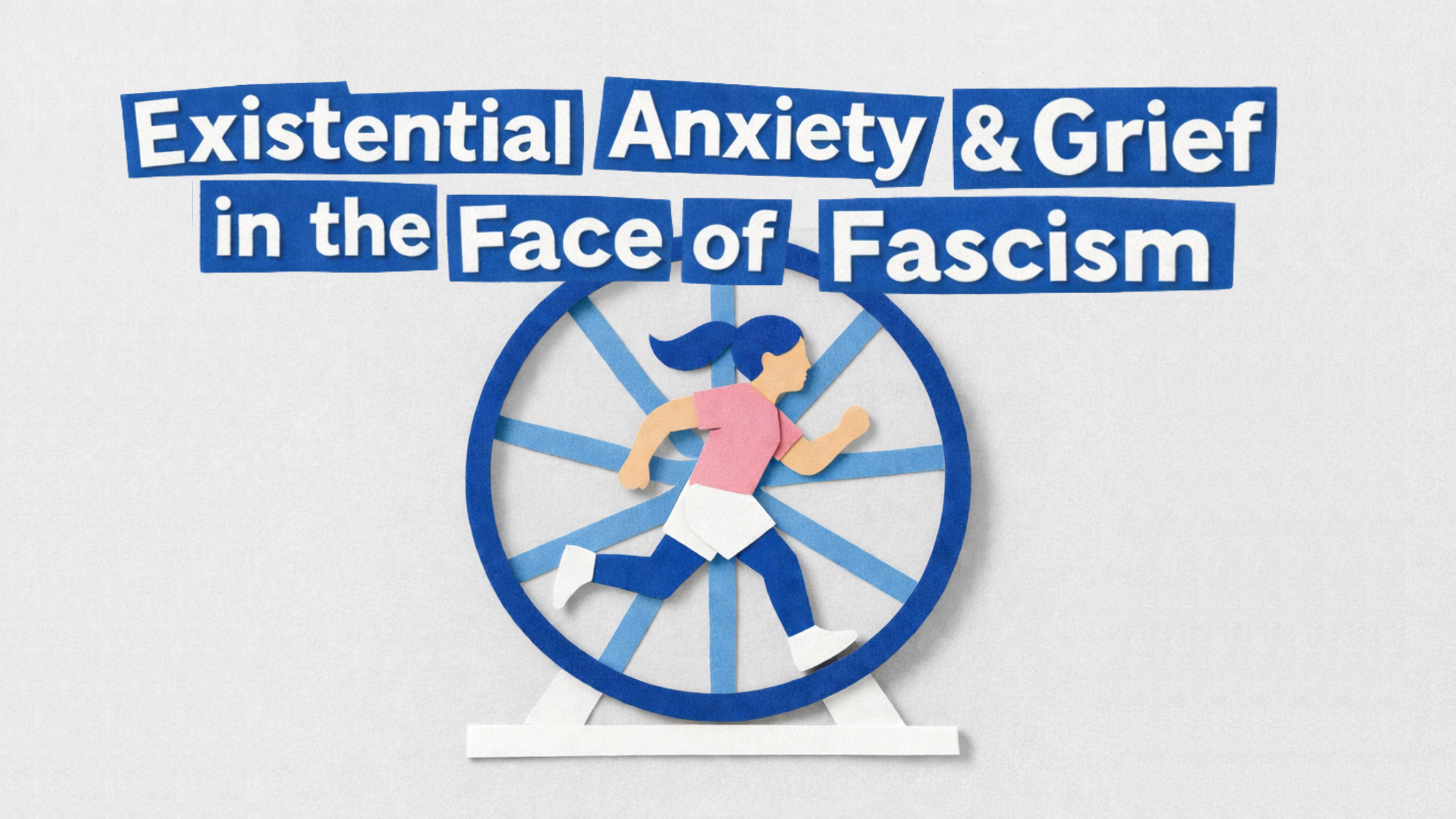
Anxiety is a hamster wheel that allows you to experience movement from fear and grief without trajectory.
Anxiety As a Hamster Wheel
Let’s start here: anxiety is not an emotion–it’s a coping mechanism. It's one that helps us avoid feeling whatever emotions are bubbling underneath the surface of our anxiety, usually fear and grief, usually existential fear and grief. By existential fear and grief, I mean fear and grief that is rooted in phenomena that affect all humankind, regardless of individual experiences or identity. Matters of death, control, uncertainty, isolation, and meaning-making most often undergird powerful anxiety spells because they are the most fundamental to our existence.
Anxiety is a hamster wheel that allows you to experience movement from fear and grief without trajectory. Anxiety gives us a way to feel like we’re doing something to exert control over a situation where we actually have none. For example, ruminating (aka overthinking) about whether or not it will rain during your marathon run does not actually prevent the skies from opening up. The weather is going to do whatever it’s going to do whether or not you’re anxious about it. This is a way of avoiding grief and fear–more on this in a bit.
Anxiety is a way of denying reality in favor of maintaining some degree of personal comfort about what we are facing. In many ways, fascist governments rely on anxiety’s immobilizing qualities to help grease the wheels of the fascist machine–it’s hard to stay connected to what the government is actually doing when you’re too busy ruminating over which is the “right” protest to attend. Confronting grief and loss is inherent and integral to fighting against fascism, both on a personal and structural level.
Grief Is Not Only an Emotion, but also a Process
Grief is not just being sad when a loved one dies, but is broadly defined as the body’s natural response to loss. We have almost no cultural framework for grief, but especially not for what’s called disenfranchised grief, which is any kind of grief not related to the death of a loved one (i.e. grief over a celebrity’s death, grief over one’s loss of innocence, anticipatory grief before someone dies, etc.).
The ability to mark the experience of a loss, give shape to your feelings and hold space for them, is essential to the grieving process. Without the acknowledgement of loss, grief often gets transmuted in other ways–anxiety, anger, even physical pain or illness. Existential grief is even less acknowledged and therefore harder to comprehend. Often existential grief comes up when we grapple with the fact that so much of life is beyond our control. Like in the marathon example above, there is grief in the fact that we cannot control the weather, that the weather might affect our running performance, that such an exciting event might be dampened by bad weather. Acknowledging this grief allows us to move beyond rumination, understand what is within our agency to act on, and make decisions accordingly.
Existential Grief for Lunch
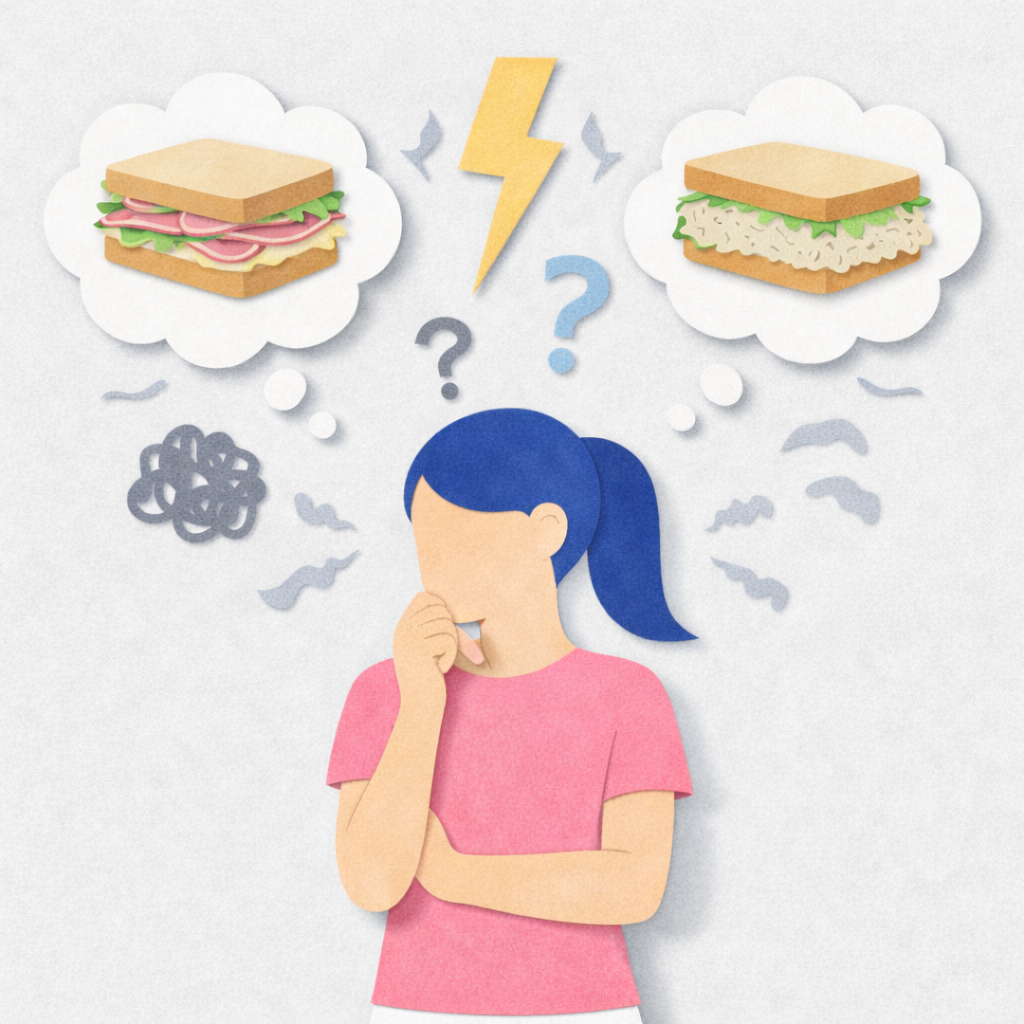
My favorite example of existential grief is this: It’s lunchtime and you only have room in your stomach for one sandwich, and you have to choose between a ham and tuna sandwich, choosing one inherently means losing out on the other. This cannot be avoided. If you choose the tuna, you lose out on the ham. Loss cannot be avoided in life, even when it comes to choosing what to eat for lunch.
Accepting Reality As It Is, Not As How We Want It To Be
In that vein, my brilliant supervisor, Andrew Triska, LCSW, once gave me a list of “some realities to accept in these trying times:”
Worrying is not activism.
You cannot prevent or anticipate all catastrophes - no amount of worrying will get you to know what will happen in the future any faster, nor will it prevent how much a bad thing will suck if/when it actually happens.
You will do the wrong thing sometimes. You will act in ways that you may later regret.
You will often have to choose between helping others and helping yourself - you cannot stop that choice from hurting badly no matter which one you choose.
You only have a single weak shitty body and 24 hours in a day.
Your body will want a mimosa even while the world is burning (and you will spend $20 on said mimosa that you could donate to a worthy cause).
Many of us have been given a blueprint, by our families and society, that living within a certain political climate, a certain socioeconomic bracket, even a certain gender is the only path toward a meaningful life. Much of our anxiety comes from the clash between what we have been promised and what we have actually been given. Understanding that what we have been promised was always a fantasy is both devastating and freeing. Once we can think about making meaning of our lives, even and especially under fascism, as being not only possible but imperative, many new opportunities can unfurl in front of us.
Getting Real with Gratitude and Building Community
Suffering is an inevitable part of life (sorry!). You cannot avoid it. In fact, often the ways in which we try to avoid suffering actually induce more suffering. Having feelings, even, and especially, when they’re devastating, is central to Being Alive. You have to feel them. Otherwise what’s the point?
The only way toward creating any kind of better future for ourselves and others is being willing to accept reality, no matter how profoundly shitty, and forge a path forward anyway. People do this in a variety of ways, none of which are right or wrong. All have the potential to become rife with anxiety if you’re engaging with them as a way to exert control over the uncontrollable instead of engaging with them because it feels aligned with your integrity, and reality, to do so. Some folks funnel their grief into protesting as a way to exert pressure on politicians or corporations, or to interrupt some part of the fascist machine. Some folks organize and fundraise, either for decent politicians, organizations that helped marginalized folks, or for direct mutual aid. Some folks make sure that the people in their life–friends, neighbors, community members–are materially taken care of and step in to help when they’re not. Some people let themselves feel their rage and grief deeply, and invite others to do so with them.
Let’s Connect!
If you’re looking for someone to hold your rage, grief, fear, and anxiety with you, reach out to me. I’d be honored to help you make sense of the world around us together.

My name is Caryn Sherbet (they/them) and I am a licensed psychotherapist based in Brooklyn, New York.
My boundary-expansive approach empowers my clients in overcoming challenges and embracing “otherness”.
I offer unique expertise in treating many conditions of the human experience, including:
OCD, anxiety, and/or rumination
Chronic illness and/or pain
LGBTQ+ Identity
Understanding relationship patterns and/or conflict
Sexual “dysfunction” and associated experiences
Self-conceptualization, meaning-making, and finding purpose
Read more about






The information in this blog is for educational purposes only and is not intended to be a substitute for professional mental health advice, diagnosis, or treatment.
Interaction with this blog, including comments or messages, does not constitute a therapist-client relationship. If you are in crisis, please call 911, go to the nearest hospital emergency room, or call a crisis hotline (988) immediately.